If you need a Fresno bus accident lawyer, early action is critical. Bus accident cases are legally complex and time-sensitive in ways that ordinary car accident claims are not. Whether the collision involves a private charter bus, school bus, tour company, or Fresno Area Express (FAX) public transit vehicle, the legal framework shifts immediately. Unlike standard auto accidents, bus collisions frequently involve multiple injured parties, commercial insurance carriers with aggressive defense teams, or government entities with mandatory pre-litigation procedures. The difference between a strong claim and a weak one often comes down to how quickly evidence is preserved and whether critical deadlines are met.
Why Bus Accident Cases Require a Different Legal Strategy
Bus accident claims differ from ordinary auto collisions in three fundamental ways. First, the duty of care is higher — California classifies bus operators as common carriers, which means they owe passengers the highest standard of care recognized by law, exceeding what applies to ordinary drivers. Second, the procedural rules are stricter — claims against government-operated transit vehicles like FAX must follow the California Government Claims Act, which imposes a mandatory six-month filing deadline before any lawsuit can proceed. Third, the opposing parties are more formidable — commercial carriers deploy rapid response claims teams within hours of an accident, and government transit agencies have experienced legal departments that handle these claims regularly.
Fresno sits at the intersection of Highway 99 and Highway 41, two of the Central Valley’s highest-volume transportation corridors. FAX operates more than 15 fixed routes throughout the city, and private charter, school, and intercity bus operators add hundreds of additional large vehicles to local roads daily. When a collision occurs in this environment, injured passengers, pedestrians, and other motorists need representation that understands both the procedural complexity and the evidence demands specific to bus accident litigation.
Common Carrier Duty of Care
Under California law, bus operators classified as common carriers owe passengers the highest duty of care. This means they must do everything reasonably possible to protect every person in their care — from the moment of boarding through the moment of safe exit. Any failure to meet that standard, whether through driver error, mechanical failure, inadequate training, or unsafe operational practices, creates a basis for legal liability. This elevated standard also extends to pedestrians and other road users who are foreseeably at risk from the bus operator’s conduct.
Why the First 72 Hours Are Critical
Bus accident cases have some of the shortest evidence windows of any personal injury claim. Onboard surveillance footage is typically overwritten on 30-to-72-hour cycles. Maintenance logs, dispatch records, and driver qualification files must be formally preserved before they can be altered or destroyed. If a government-operated vehicle is involved, the six-month claim deadline begins running on the date of injury — not the date symptoms worsen or treatment begins. An attorney who begins the evidence preservation process immediately after a Fresno bus accident gives the injured party an advantage that cannot be recovered later.
What We Bring to Your Case
Disciplined preparation. Direct access. No fee unless we win.
Two Types of Fresno Bus Cases — Different Rules for Each
Bus accident claims in Fresno fall into two distinct legal categories, each with its own liability framework, insurance structure, procedural deadlines, and defense tactics.
Private carrier cases involve charter buses, tour buses, school buses operated by private contractors, and intercity coach lines. These are governed by commercial negligence law and federal transportation regulations enforced by the Federal Motor Carrier Safety Administration (FMCSA). The standard two-year California personal injury statute of limitations generally applies.
Public entity cases involve Fresno Area Express and other government-operated transit vehicles. These are governed by the California Government Claims Act, which requires a formal written claim to be filed with the public entity within six months of the injury date under California Government Code § 910 before any lawsuit can be filed. Missing this deadline can permanently eliminate recovery regardless of how strong the underlying liability case is.
Getting the category wrong — or treating a public entity case like a standard auto claim — can be fatal to an otherwise valid claim. For general crash liability principles that apply across both categories, see our Car Accident Lawyer overview. For commercial vehicle negligence analysis, see our Fresno Truck Accident Lawyer page.
Common Causes of Fresno Bus Accidents
Identifying the exact cause of a bus collision is the foundation of the liability case. Each cause pattern produces different evidence requirements, different legal theories, and different responsible parties.
Driver-Related Causes
Driver fatigue from split shifts or excessive hours is among the most common contributing factors in serious bus collisions. Federal hours-of-service regulations exist precisely because fatigued commercial drivers create catastrophic risk. Other driver-related causes include distracted driving and mobile device use in violation of California Vehicle Code § 23123.5, impaired driving, inadequate training for high-density urban routes, failure to yield at intersections or crosswalks, and improper lane changes on multi-lane Fresno arterials.
Mechanical and Maintenance Failures
Brake failures from deferred maintenance, tire blowouts from worn or improperly inflated tires, door malfunctions during passenger boarding and exiting, and steering system failures are all documented causes of bus accidents in California. Carriers are required to maintain inspection and maintenance records for every commercial passenger vehicle. When a mechanical failure occurs on a bus with a documented history of deferred maintenance, the negligent maintenance claim against the carrier is direct and well-supported. Obtaining those records requires formal legal process — they are not produced voluntarily.
Operational and Environmental Causes
Overloaded passenger capacity creating vehicle instability, unsafe turns on narrow Fresno side streets, and congestion-related rear-end collisions on Highway 99 contribute to the bus accident picture in the Central Valley. Tule fog — a persistent weather hazard between November and March — significantly reduces visibility on Highway 99 and Highway 41 during early morning hours and is a contributing factor in some of the most catastrophic bus accident events seen in this region. The Caltrans District 6 office maintains incident data for these corridors.
FAX Transit Claims — Government Entity Procedures
When a bus accident involves Fresno Area Express, the legal process is fundamentally different from a standard personal injury claim. FAX is operated by the City of Fresno Department of Transportation. As a municipal agency, it carries governmental immunity protections that do not apply to private carriers — but those immunities are not absolute.
Liability can still attach when injury results from negligent operation of a government vehicle, a dangerous condition of public property, or failure to maintain transit equipment in a reasonably safe condition. The procedural path to recovery, however, is strictly regulated.
The Six-Month Government Claim Deadline
A formal written claim must be filed with the City of Fresno within six months of the injury date under California Government Code § 910. Once filed, the city has 45 days to accept or reject the claim. If rejected, the claimant has six months from the rejection date to file a lawsuit. If the city fails to respond, the claimant has two years from the incident date to sue. These timelines run simultaneously with ongoing medical treatment and recovery — making early attorney involvement essential to meeting them without interruption.
Cross-Jurisdictional Transit Routes
The Fresno metropolitan area includes transit operations connecting to Clovis, Madera, and surrounding communities. Accidents involving cross-jurisdictional routes may implicate multiple public entities, each with its own claims procedures and deadlines. Identifying every potentially liable government entity in the first days after an accident is a critical step that attorneys perform during early case evaluation.
Private Bus Company Negligence
Private carriers operating in and around Fresno — charter companies, school transportation contractors, tour operators, and intercity coach lines — are subject to commercial negligence standards and FMCSA federal transportation regulations. These claims proceed on standard civil litigation timelines, but the evidence demands are equally urgent.
Negligence Theories in Private Carrier Cases
Negligent hiring occurs when a carrier retains a driver with a disqualifying record or insufficient licensure. Negligent training involves failure to provide adequate instruction for the routes and conditions the driver is expected to operate in. Negligent supervision covers the absence of monitoring systems or hours-of-service compliance review. Negligent maintenance addresses failure to perform scheduled inspections or repair known mechanical defects. Each theory requires specific documentation that must be formally obtained through the discovery process.
FMCSA Regulatory Violations as Evidence
Violations of federal regulations — driver hours-of-service limits, commercial driver’s license requirements, drug and alcohol testing mandates, vehicle inspection standards — are directly admissible as evidence of negligence in California courts. A carrier whose driver exceeded legal driving hours before a fatigue-related collision has handed the plaintiff a direct line of liability. Obtaining compliance records requires a formal subpoena, and carrier data retention windows are limited.
Commercial Insurance Defense Tactics
Commercial passenger carrier policies carry significantly higher limits than private auto policies — and higher limits mean more aggressive, better-funded defense. Carriers routinely deploy rapid response teams to accident scenes before injured parties have retained counsel. Common tactics include minimizing injury severity in early recorded statements, attributing the collision to a sudden stop or third-party driver, asserting comparative fault against passengers for standing without holding a rail, and presenting early settlement offers before the full extent of injury is known. Understanding these tactics before any communication with a carrier representative is essential to protecting your claim’s full value.
High-Risk Fresno Bus Accident Corridors
Fresno’s street grid and transit network concentrate bus accident risk in specific, identifiable locations. Understanding where collisions cluster strengthens foreseeability arguments in negligence cases and supports route-specific safety violation claims.
Downtown Fresno Transit Hub
The downtown Fresno transit center near Tulare Street and Van Ness Avenue serves as the convergence point for multiple FAX routes. High pedestrian density, bus layovers, and tight turning radii in the downtown grid create frequent opportunities for boarding and exiting accidents, pedestrian strikes, and low-speed intersection collisions.
Blackstone Avenue Corridor
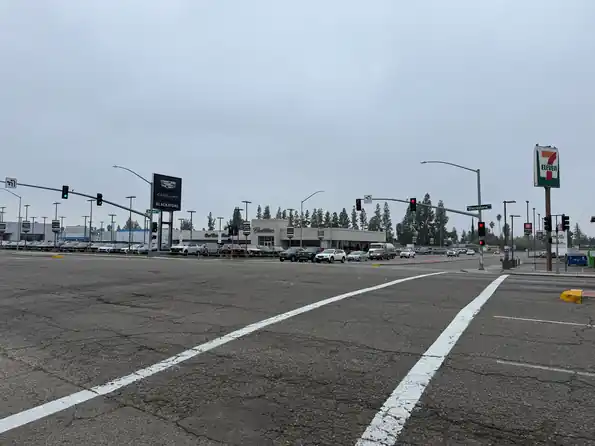
Blackstone Avenue carries substantial FAX route traffic between downtown and the northern commercial districts. Multiple signalized intersections, high pedestrian crossing volume, and frequent bus stop activity create conditions for rear-end collisions, pedestrian strikes at crosswalks, and door-related injuries during passenger loading and unloading.
Shaw Avenue and Fresno State Area
Shaw Avenue intersects with several high-volume FAX routes near California State University Fresno. Student pedestrian traffic, bicycle riders, and bus route activity in the Shaw and Cedar Avenue intersection zone create elevated multi-party collision risk during peak academic hours.
Highway 99 and Highway 41 Approaches
Charter buses, tour operators, and intercity coaches use Highway 99 and Highway 41 as primary approach corridors. Tule fog events between November and March create high-speed rear-end collision risk for large vehicles on these routes — among the most catastrophic accident categories handled by Central Valley personal injury attorneys.
School Zones and Fresno Unified Routes
School bus operations serving Fresno Unified School District campuses create recurring exposure in residential neighborhoods throughout central and southeast Fresno. School bus accidents may involve the district directly, a contracted transportation provider, or both — each presenting different liability and procedural considerations. Claims on behalf of minor children require a parent or guardian to file and involve additional legal steps not present in standard adult injury claims.
Injuries in Fresno Bus Accidents
Bus accidents produce a severe injury profile. Unrestrained passengers, standing riders, and the enormous mass differential between a transit bus and the human body mean that even moderate-speed collisions generate forces capable of causing life-altering harm.
Traumatic Brain Injuries
Sudden deceleration in a bus collision causes passengers to strike interior surfaces with significant force. TBI symptoms — cognitive impairment, persistent headache, light sensitivity, memory disruption — are not always immediately apparent. A passenger who appears stable at the scene may be experiencing a developing intracranial injury requiring urgent diagnosis. See our Traumatic Brain Injury Lawyer page for detailed information on TBI claims.
Spinal and Back Injuries
Herniated discs, vertebral fractures, and spinal cord damage are common in bus accident collisions. Permanent spinal injuries require future care planning, vocational rehabilitation analysis, and forensic economic valuation that must be developed before any settlement is considered final. See our Spinal Cord Injury Lawyer page.
Fractures and Orthopedic Injuries
Arm, wrist, leg, and hip fractures occur when passengers brace for impact or are thrown against interior structures. Elderly passengers face elevated risk for hip fractures requiring surgical intervention and extended rehabilitation.
Internal Injuries
Blunt abdominal trauma can produce splenic laceration, liver injury, and lung contusion without obvious external signs. These are medical emergencies. Internal trauma claims require detailed records connecting the collision mechanics to the specific injuries sustained.
Pedestrian Bus Accident Injuries
Pedestrians struck by buses sustain some of the most severe injuries in any traffic accident category. Even low-speed impacts from a transit bus can cause fatal or catastrophic injuries to a pedestrian. Crosswalk accidents near FAX route stops and school zones represent the highest-risk pedestrian exposure zones in Fresno. In fatal incidents, families may pursue claims through our Fresno Wrongful Death Lawyer page.
Evidence That Must Be Preserved Immediately
The strength of a bus accident claim is frequently determined by what is collected — or lost — in the first 72 hours. Bus operators and their insurers begin their own evidence collection process within hours of a collision. Injured parties deserve the same advantage.
Onboard surveillance footage from interior and exterior cameras is overwritten on 30-to-72-hour cycles. A formal written preservation demand must go to the carrier or transit agency immediately. Driver hours-of-service logs establish whether the driver exceeded legal driving time limits before the crash. Maintenance and inspection records document whether known mechanical defects went unaddressed. Dispatch and GPS route data can establish speed deviations and pre-crash communications. Government incident reports filed by FAX after any collision contain admissions and findings that may be directly useful in a negligence claim and are obtainable through public records requests.
Compensation in a Fresno Bus Accident Case
California law recognizes both economic and non-economic damages in personal injury cases. Total recovery depends on injury severity, the strength of liability evidence, the quality of the medical documentation, and available insurance coverage from all responsible parties.
Economic damages include all past and future medical expenses causally connected to the collision, lost wages during recovery, diminished future earning capacity when injuries are permanent or career-limiting, and documented out-of-pocket expenses. Future medical expense and lost earning capacity claims require qualified expert testimony from life care planners, treating physicians, and forensic economists.
Non-economic damages compensate for physical pain and suffering, emotional distress, post-traumatic stress disorder, loss of enjoyment of activities the injured party previously engaged in, and loss of consortium for spouses and domestic partners.
Punitive damages may be available against private carriers whose conduct reflects conscious disregard for passenger safety — such as knowingly operating a vehicle with documented mechanical defects or retaining a driver with a known history of serious violations. Punitive damages are not available against public entities.
Wrongful death damages are available to surviving family members when a bus accident results in a fatality under California Code of Civil Procedure § 377.60. See our Fresno Wrongful Death Lawyer page.
Comparative Fault in Fresno Bus Cases
California follows a pure comparative fault system under California Civil Code § 1714. Even if an injured party shares partial responsibility for a collision, recovery is not eliminated — it is reduced proportionally. Commercial carriers routinely attempt to shift fault onto injured parties to reduce payout exposure, arguing that passengers were standing in prohibited areas, that pedestrians crossed outside marked crosswalks, or that a third-party driver was the sole proximate cause. Independent accident reconstruction, witness testimony, and complete medical documentation are the primary tools for defeating these arguments.
Fresno Practice Areas
Why Fresno Bus Accident Victims Choose Dhanjan Injury Lawyers
Bus accident cases require an attorney who understands both the procedural complexity of public entity claims and the commercial litigation tactics deployed by private carrier insurers. The window to act is short, the evidence is perishable, and the opposing parties are experienced and well-resourced.
Trial-ready preparation from day one. Every case we handle is built as if it will go before a Fresno County Superior Court jury. That standard of preparation is what produces leverage when carriers refuse to offer fair value.
Direct attorney access throughout your case. You work directly with your attorney from the first consultation through final resolution — not a case manager or paralegal for substantive communications.
No fee unless we recover for you. We handle bus accident cases on a contingency fee basis. No upfront costs, no attorney fees unless we win. Our fee comes from the recovery.
Central Valley focus. We know Fresno’s corridors, the local courts, and the defense tactics used by carriers operating in this region. That familiarity translates into more effective preparation and more credible litigation presence in Fresno County Superior Court.
Need a Fresno Bus Accident Lawyer?
Speak with an Attorney and understand your next steps
Fresno Bus Accident Frequently Asked Questions
What is the deadline to file a claim against Fresno Area Express?
If your injury involves FAX or another public transit agency, you must file a formal government claim within six months of the date of injury under the California Government Claims Act. This deadline begins on the date of the incident — not when symptoms worsen or treatment begins. Missing it can permanently bar recovery regardless of how strong your underlying case is. Contact an attorney immediately if a government vehicle was involved.
Are bus companies liable for injuries caused by sudden stops?
Bus operators owe passengers a heightened duty of care as common carriers. Sudden stops do not automatically establish negligence — liability depends on whether the stop was necessary, whether the driver was operating at a reasonable speed, and whether the stop resulted from distraction, mechanical failure, or an avoidable hazard. Onboard camera footage and driver conduct records are central to evaluating these claims.
Can pedestrians recover compensation after being hit by a FAX bus?
Yes. Pedestrians struck by public transit vehicles may recover compensation through a government claim against the City of Fresno. Recovery depends on liability evidence, comparative fault analysis, and compliance with the six-month government claim deadline. These cases typically require accident reconstruction and video evidence to establish the full sequence of events.
What if I was injured while boarding or exiting a bus?
Common carrier duty of care extends through the entire boarding and exiting process. Injuries during these transitions may involve unsafe stopping positions, door malfunction, uneven pavement at the stop, or failure to assist passengers with disabilities properly. These claims focus on operational safety protocols and whether the carrier met the heightened standard required under California law.
What if the bus accident involved a Fresno Unified school bus?
School bus cases involving Fresno Unified School District or other public school operators are subject to the same six-month government claim deadline. Claims on behalf of minor children require a parent or guardian to file and involve additional procedural steps. Liability analysis in school bus cases includes driver training standards, supervision practices, and the safety of the boarding and dismissal process.
Should I give a recorded statement to the bus company’s insurance carrier?
No. You are not legally required to provide a recorded statement to an opposing carrier. These statements are taken to establish comparative fault positions and minimize injury severity before the full extent of harm is known. Decline any recorded statement requests and consult with an attorney before communicating substantively with any carrier representative.
Can I still recover if I was partially at fault for the accident?
Yes. California’s pure comparative fault system allows recovery even when the injured party shares partial responsibility. Your total compensation is reduced by your fault percentage — not eliminated. Carriers routinely inflate the injured party’s fault to reduce payouts. Independent evidence and legal representation are the most effective tools for preventing unfair fault allocation.
How long do Fresno bus accident cases take to resolve?
Public entity cases often take longer than standard auto claims because of mandatory government claims procedures and defense review timelines. Private carrier cases proceed on standard civil litigation schedules. Cases involving permanent injuries routinely take 18 to 36 months from incident to resolution, depending on injury severity, treatment duration, and whether liability is disputed.
What evidence is most important in a Fresno bus accident case?
The most critical evidence categories are onboard surveillance footage, driver hours-of-service logs, vehicle maintenance records, dispatch and GPS data, witness statements, government incident reports, and complete medical documentation from the date of the accident forward. Most of this evidence is time-sensitive — preservation demands must go out within 24 to 72 hours of the collision.