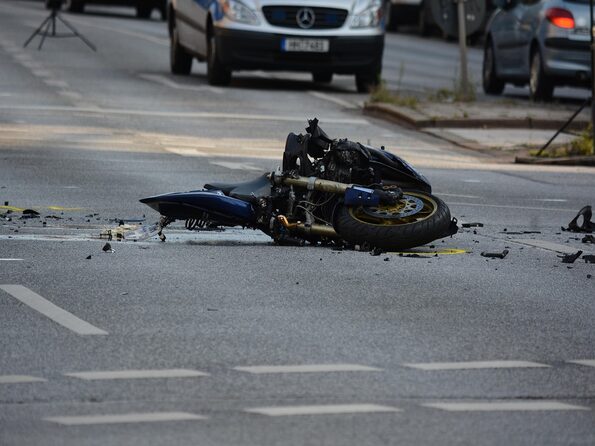
Motorcycle accident cases in Fresno require precision and early action. Riders face higher injury severity than any other road user, and insurance carriers frequently attempt to shift fault to the motorcyclist — even when the driver caused the crash. A strong claim is built on disciplined evidence preservation, consistent medical documentation, and a damages strategy that anticipates and neutralizes the defenses carriers deploy in rider injury cases.
Fresno motorcycle collisions frequently occur along Shaw Avenue, Blackstone Avenue, Herndon Avenue, Cedar Avenue, Clovis Avenue, and the Highway 41 and Highway 99 corridors managed by Caltrans District 6. These routes combine heavy congestion, frequent lane changes, left-turn conflicts, and sudden stops — exactly the conditions that produce rider injury claims and liability disputes.
Why Motorcycle Accident Claims Are Different
Motorcycle claims differ from standard vehicle collisions in three fundamental ways that shape every aspect of how the case must be built.
Injury severity is categorically higher. Riders have no structural protection — no airbag, no crumple zone, no seatbelt. Even moderate-speed impacts routinely produce fractures, traumatic brain injuries, spinal cord damage, and life-altering disability. According to the National Highway Traffic Safety Administration, motorcyclists are dramatically overrepresented in fatal crash statistics relative to their share of road use — a disparity driven entirely by the absence of structural occupant protection.
Liability is systematically disputed. The phrase “I didn’t see the motorcycle” is the single most common statement made by at-fault drivers in rider injury cases. Insurers attempt to convert that statement into a comparative fault argument — asserting that if the driver couldn’t see the rider, the rider must have been riding unsafely. The correct legal response is to establish what actually happened through objective evidence, not to accept the driver’s characterization of visibility as a fault determination.
Insurance bias against riders is real. Motorcyclists are routinely labeled as reckless in early carrier assessments regardless of the facts. Adjusters are trained to open comparative fault positions aggressively in rider cases because the average jury carries cultural assumptions about motorcycle riding that carriers exploit. Countering that bias requires case preparation that makes the objective evidence impossible to ignore.
If your crash involved a commercial vehicle, your case may overlap with commercial liability issues — see our Fresno Truck Accident Lawyer page. For catastrophic injury valuation, see our Spinal Cord Injury Lawyer page. For fatal collisions, see our Fresno Wrongful Death Lawyer page. For statewide legal context, see our Car Accident Lawyer overview.
Lane Splitting in California — What the Law Actually Says
California is the only state that explicitly permits lane splitting. Under California Vehicle Code section 21658.1, riders may lawfully travel between lanes of same-direction traffic when done safely. The California Highway Patrol has published lane splitting safety guidelines that serve as the practical reference for what constitutes reasonable conduct.
Despite this, insurers routinely assert that lane splitting at the time of a collision constitutes automatic comparative fault. It does not. Liability depends on what actually occurred and whether the specific conduct was reasonable under the circumstances — not on the abstract fact that lane splitting was happening. The relevant questions are the traffic speed and congestion conditions at the moment of impact, the rider’s speed relative to surrounding traffic, lane position and visibility, and the specific driver action — an unsafe lane change, a sudden turn, distracted driving — that caused the collision. The correct strategy is to prove what occurred through video evidence, witness accounts, impact patterns, and scene documentation.
Fresno Practice Areas
Common Causes of Fresno Motorcycle Accidents
Motorcycle collisions in Fresno follow identifiable, recurring patterns driven by driver negligence. Each pattern requires different evidence and supports different legal theories — which is why understanding the specific cause mechanism is the foundation of the liability case.
Left-turn collisions are the most common and most deadly pattern — a vehicle turns left across a rider’s lane of travel, creating a direct broadside impact the rider cannot avoid. Failure to yield at intersections and merge points generates a significant share of serious rider injuries along Fresno’s signalized corridors. Unsafe lane changes occur when drivers move laterally without checking mirrors or blind spots, directly into a rider’s lane. Distracted driving — phone use, infotainment interaction, and inattention — contributes to a substantial percentage of rider injury collisions given how little time a distracted driver needs to miss a motorcycle entirely. Rear-end impacts in congestion and at sudden stops throw riders forward with forces that produce severe orthopedic and spinal injuries. Dooring occurs when a parked vehicle occupant opens a door into active traffic without checking for approaching motorcycle traffic. Road hazards including debris, potholes, gravel, and uneven pavement create loss-of-control events that may implicate drivers, contractors, or government entities depending on the specific circumstances.
Fresno High-Risk Corridors for Riders
Motorcycle risk concentrates where traffic density, speed changes, and lane conflicts combine. Blackstone Avenue’s retail corridor generates constant turning movements, lane changes, and congestion that create repeated right-of-way conflicts for riders. Shaw Avenue’s commercial intersections produce frequent turns and stop-and-go patterns that are particularly dangerous when left-turning vehicles fail to yield to riders proceeding on green. Herndon Avenue’s commuter flow creates speed variation and merging conflicts at volume during peak hours. The Cedar Avenue and Clovis Avenue corridors combine intersection conflict with high commuter volume. The Highway 41 and Highway 99 connectors generate high-speed merge conflicts and chain-reaction crashes — and tule fog between November and March dramatically reduces visibility on both corridors, creating conditions where motorcycle operation carries substantially elevated risk during early morning commute hours.
Evidence Priority by Corridor
This ranking reflects evidence preservation priority based on traffic density and recurring conflict patterns — not official crash counts. For official collision statistics, California’s SWITRS crash reporting system is the appropriate reference.
What To Do After a Fresno Motorcycle Accident
The first steps after a motorcycle collision often determine whether an insurer can successfully discount your claim later. The carrier’s adjuster begins their own evidence collection process within hours of receiving notice — and the window to preserve critical evidence is narrow.
Get medical care immediately and do not wait to see how you feel — TBI symptoms and internal injuries are not always apparent at the scene. Request a Fresno Police Department response and obtain the traffic collision report number before leaving. Photograph the scene comprehensively before anything is moved: lane position, skid marks, debris fields, signal status, road surface conditions, and all vehicle damage. Preserve any helmet cam or dashcam footage immediately and prevent devices from overwriting. Collect witness names and contact information before they disperse. Do not give a recorded statement to any insurance carrier until you understand your rights. Track all symptoms, medications, appointments, and missed work days from day one — this documentation becomes the spine of your damages presentation.
How Fault Is Proven in Fresno Motorcycle Cases
Motorcycle cases are negligence claims. Liability is established by proving duty of care, breach of that duty, causation connecting the breach to the injuries, and documented damages. The earlier the claim is structured and the evidence organized, the harder it becomes for a carrier to successfully challenge the liability picture.
Comparative Fault and Rider Bias
California follows a pure comparative fault system. If a carrier can assign partial fault to the rider — even 10 to 20 percent — they reduce their payout obligation accordingly. Insurers pursue this in motorcycle cases more aggressively than in almost any other personal injury category, using allegations of excessive speed, unsafe lane position, or reckless riding asserted without objective support. The evidence that defeats these arguments includes video from helmet cams, dashcams, and nearby surveillance; early witness statements gathered before memories fade; impact geometry and vehicle damage patterns that establish approach angles and speeds; scene photographs documenting lane position and signal status; and accident reconstruction in cases where liability is seriously disputed.
Left-Turn Collisions and Right-of-Way Disputes
The left-turn collision — a driver turning left across a rider’s lane of travel — is the most common mechanism in serious and fatal motorcycle crashes. These cases turn on visibility, timing, signal phase, and right-of-way. The driver who failed to yield consistently claims they never saw the motorcycle. The evidence that establishes what actually occurred includes the signal phase and intersection configuration at the moment of impact, witness accounts of the turn and the rider’s lane position, video from nearby business cameras and traffic monitoring systems preserved before footage overwrites, and the physical evidence of skid marks, debris fields, and final vehicle positions that establish impact geometry and approach speeds.
Road Hazard Claims — Debris, Potholes, and Government Entity Liability
Road hazard crashes introduce complexity that pure driver negligence cases do not have. Liability may involve the at-fault driver, a roadway contractor, or a governmental entity depending on what created the hazard, who was responsible for maintaining that roadway segment, and whether the responsible party had notice of the dangerous condition. The City of Fresno Traffic Engineering Division maintains road infrastructure within city limits, and Caltrans District 6 is responsible for state highway conditions including Highway 41 and Highway 99 through Fresno.
Road hazard cases require immediate evidence action because the hazard disappears — it gets filled, swept, or repaired before anyone documents it. Documentation must include photographs and video from multiple angles, exact GPS location, witness statements, and evidence of prior notice through maintenance records or prior complaint documentation. When a public entity is involved, the six-month government claim deadline under California Government Code section 835 applies strictly. Missing it permanently bars recovery regardless of how clear the underlying liability is.
Catastrophic Injuries in Fresno Motorcycle Collisions
Motorcycle collisions produce severe injuries at a rate that far exceeds other personal injury categories. Traumatic brain injuries — from concussion-level symptoms to permanent cognitive impairment — occur even in helmeted riders when impact forces exceed what helmet protection can absorb. Spinal cord injuries and neurological impairment from direct vehicle impact or rapid deceleration can produce permanent disability requiring lifetime care planning. Multiple fractures and orthopedic damage are among the most common surgical injury categories in rider cases. Internal organ trauma from blunt abdominal force and rib fractures compressing lung tissue can be life-threatening emergencies not immediately apparent at the scene. Severe road rash and permanent scarring require surgical debridement, skin grafting, and extended wound care that must be fully documented and accounted for in the damages calculation.
For catastrophic injury valuation and future care planning analysis, see our Spinal Cord Injury Lawyer page. In fatal cases, see our Fresno Wrongful Death Lawyer page.
Helmet Use, Insurance Arguments, and Medical Documentation
California requires helmet use for all motorcycle riders under California Vehicle Code section 27803. Insurers frequently attempt to use helmet discussions to reduce claim value — arguing that helmet non-compliance contributed to head injuries, or that a helmeted rider should have sustained less injury than documented. Neither argument eliminates liability for the crash itself. Injury causation and damages are evaluated based on medical evidence and the specific mechanics of the collision, not on helmet use as a standalone variable.
In serious injury cases, the medical timeline is the backbone of the claim. Gaps in care allow insurers to argue that injuries were not serious or were not caused by the crash. High-value motorcycle cases require objective diagnostics including imaging and specialist evaluation, clear symptom progression documentation, consistent follow-up and treatment compliance, and thorough functional limitations documentation covering both work capacity and daily life impact.
Insurance Company Tactics in Fresno Motorcycle Claims
Motorcycle claims are defended aggressively because injuries are often severe and the corresponding damages are substantial. Carriers claim reckless riding without any objective evidence to support the characterization. They misrepresent lane splitting as automatic fault despite the clear legal standard under California law. They minimize injury severity through early recorded statements designed to elicit characterizations that undercut future medical claims. They invoke pre-existing condition arguments to reduce the damages attributable to the crash. They pressure early settlement before long-term prognosis and future care needs are established. And they manufacture comparative fault arguments using whatever factual ambiguity an underdeveloped evidence record leaves open. Understanding this playbook from day one is the prerequisite to building a claim that withstands it.
Uninsured and Underinsured Driver Coverage
Uninsured and underinsured drivers remain a significant practical problem in Fresno motorcycle cases. When the at-fault driver carries no insurance or limits insufficient to cover serious rider injuries, your own uninsured motorist (UM) and underinsured motorist (UIM) coverage may provide a recovery path. Reviewing all available coverage sources — including your own motorcycle policy — is a critical early step in any claim evaluation. UM and UIM claims against your own carrier involve their own procedural requirements and deadlines that must be handled correctly from the outset to preserve coverage.
What We Bring to Your Case
Disciplined preparation. Direct access. No fee unless we win.
Compensation Available in Fresno Motorcycle Accident Claims
California law recognizes both economic and non-economic damages in personal injury cases arising from motorcycle collisions. Economic damages include all past and future medical expenses causally connected to the crash, lost income during recovery, diminished future earning capacity when injuries are permanent or career-limiting, motorcycle and equipment replacement, and documented out-of-pocket costs. Non-economic damages compensate for physical pain and suffering, emotional distress, post-traumatic stress disorder, permanent disfigurement and scarring, and loss of enjoyment of activities including riding. In cases involving catastrophic injury, future damages calculations require expert testimony from life care planners, treating physicians, and forensic economists to establish projected costs with the specificity required for trial or mediation.
Litigation Readiness in Fresno County
When a carrier refuses to pay fair value for a motorcycle injury claim, the case must be prepared for Fresno County Superior Court. Motorcycle cases require organized evidence, complete medical support, and a structured damages proof that accounts for both current losses and future impact. Claims built for trial from the outset consistently produce stronger negotiating positions — even when they ultimately resolve before a jury verdict. Carriers who recognize that a plaintiff’s attorney is genuinely prepared to try the case price their settlement offers accordingly.
For general crash liability context, see our Car Accident Lawyer overview. For commercial collision overlap, see our Fresno Truck Accident Lawyer page. For the full Fresno personal injury overview, see our Fresno Personal Injury Lawyer page.
Why Fresno Motorcycle Accident Victims Choose Dhanjan Injury Lawyers
Trial-ready preparation from day one. Every case is built as if it will go before a Fresno County Superior Court jury. That standard produces real leverage when carriers attempt to discount rider injury claims through bias and unsupported fault arguments.
Direct attorney access throughout your case. You work directly with your attorney from the first consultation through final resolution — not a case manager for substantive communications about your claim.
No fee unless we recover for you. We handle motorcycle accident cases on a contingency fee basis. No upfront costs, no attorney fees unless we win.
Central Valley focus. We know Fresno’s corridors, the local courts, and the specific defense tactics that carriers use against motorcycle injury claims in this region. That familiarity produces more effective case preparation and more credible litigation presence in Fresno County Superior Court.
Need a Fresno Motorcycle Accident Lawyer?
Speak with an Attorney and understand your next steps
Fresno Motorcycle Accident Frequently Asked Questions
Is lane splitting legal in Fresno?
Yes. Lane splitting is permitted in California under Vehicle Code section 21658.1 when performed safely under the traffic conditions present. The California Highway Patrol has published safety guidelines that define reasonable lane-splitting conduct. The legality of lane splitting does not automatically create fault for a collision — liability depends on what specifically occurred and whether the conduct was reasonable under the circumstances.
Does lane splitting automatically make me at fault for the crash?
No. Insurers commonly assert this, but it is legally incorrect. Fault is determined by the specific facts of the collision — who had the right of way, what each party did in the moments before impact, and whether conduct was reasonable. A driver who made an unsafe lane change into a rider who was lane splitting legally and safely may bear full liability regardless of the lane splitting.
What if the driver says they didn’t see me?
Failure to observe a motorcyclist does not eliminate driver liability when negligence is established. Every driver has a duty to observe all road users including motorcycles. Video evidence, witness accounts, impact geometry, and scene documentation frequently establish what the driver should have been able to see — and whether the failure to see the rider was itself the negligent act that caused the collision.
Can I recover if I was partially at fault?
Yes. California’s pure comparative fault system reduces recovery proportionally to your fault percentage — it does not eliminate it. A rider found 25 percent at fault still recovers 75 percent of total proven damages. Carriers open aggressive comparative fault positions in motorcycle cases as standard practice. The right evidence prevents unfair fault allocation from cutting into your recovery.
Does helmet use affect my case?
California requires helmet use under Vehicle Code section 27803. Whether helmet compliance or non-compliance affects the damages analysis depends on the specific injury mechanism, the biomechanics of the collision, and medical causation evidence. It does not eliminate liability for the crash itself. An insurer’s argument that helmet use reduces recovery is a factual and medical question requiring expert analysis — not an automatic presumption that cuts damages.
What if the at-fault driver is uninsured or underinsured?
Your own motorcycle insurance policy may include uninsured motorist and underinsured motorist coverage that provides a recovery path when the at-fault driver carries no insurance or insufficient limits. Reviewing all available coverage sources including your own policy is a critical early step. UM and UIM claims against your own carrier involve procedural requirements that must be handled correctly from the outset to preserve coverage.
How long do I have to file a motorcycle accident claim in California?
Most personal injury claims are subject to a two-year statute of limitations from the date of the accident. If a government entity contributed to the crash — such as a dangerous public road condition maintained by the City of Fresno or Caltrans — you may have as little as six months to file a formal government claim. Contact an attorney immediately if any public entity may have played a role.
Should I accept the first settlement offer after a motorcycle accident?
Not until your prognosis and future care needs are fully understood. Early offers in motorcycle cases are structured to close high-value claims before the full extent of injuries — particularly spinal, neurological, and orthopedic damage — is established by medical evaluation. Once you sign a release, the claim is permanently closed regardless of how your condition develops.
How long does a Fresno motorcycle accident case take to resolve?
Timeline depends on injury severity, treatment duration, whether liability is disputed, insurance carrier cooperation, and whether litigation becomes necessary. Cases involving catastrophic injuries routinely take 18 to 36 months. Settling before treatment is complete and the full prognosis is established is the most common mistake that permanently reduces recovery in serious motorcycle cases.
Can I recover for road rash and permanent scarring?
Yes. Permanent scarring from road rash is a compensable non-economic injury under California law. The severity, location, and permanence of scarring — particularly on visible areas of the body — directly affects non-economic damage valuation. Medical photography beginning immediately after the accident and continuing through complete healing is essential to documenting the true severity and permanence of road rash injuries.